
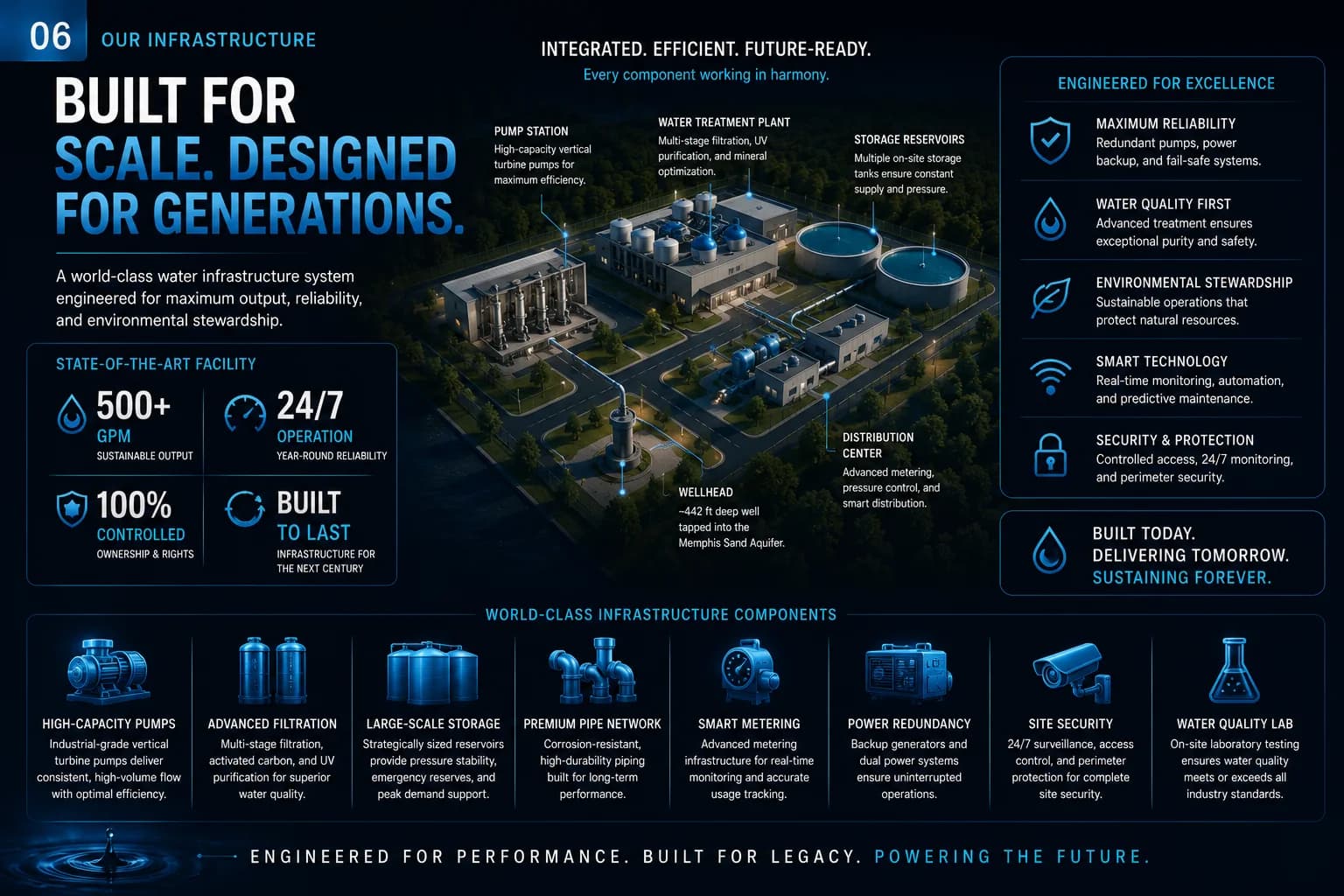
A source can be technically suitable and commercially unusable if the delivery path is not solved. Interconnection requires a defined handoff point, compatible pressure and flow conditions, metering, controls, backflow or isolation, easements, construction responsibility, commissioning, and the approvals that apply to the buyer and supplier. Loading requires storage, pumps, connection standards, traffic and turning, scheduling, driver procedures, and safe access. Hauled delivery adds carrier qualification, equipment, trip timing, receiving, and contingency.
Infrastructure is scoped against average demand, maximum demand, peak-hour behavior, storage strategy, redundancy, future expansion, and the consequence of interruption. The lowest first-cost design is not always the lowest program cost. A buyer may prefer more storage to reduce dispatch risk, a second connection to support resilience, or treatment at its own site to preserve operating control.
Aquifer Waterworks separates source-water pricing from infrastructure so each decision can be evaluated on its own life, ownership, and risk. Engineering, construction, permits, equipment, energy, maintenance, and replacement are identified as project scopes rather than hidden inside a commodity rate that makes comparison impossible.
Three delivery paths
Interconnection, loading, and hauled delivery each carry distinct engineering, access, approval, and operating requirements.
Demand profile sizes the system
Average, maximum, peak hour, storage, redundancy, growth, and interruption consequence drive design.
Infrastructure stays visible
Engineering, permits, construction, equipment, energy, maintenance, and replacement are not buried in the water rate.
System conditions and declared scope.
- Primary offer
- Raw / untreated source water
- Operating region
- Memphis Region, within the approved operating region
- Source classification
- Confined sand aquifer system
- Pricing basis
- Source water quoted separately from treatment, storage, and transport
ESSENTIAL CLARITY
Source and system questions
What does “Three delivery paths” mean here?
Interconnection, loading, and hauled delivery each carry distinct engineering, access, approval, and operating requirements.
What does “Demand profile sizes the system” mean here?
Average, maximum, peak hour, storage, redundancy, growth, and interruption consequence drive design.
What does “Infrastructure stays visible” mean here?
Engineering, permits, construction, equipment, energy, maintenance, and replacement are not buried in the water rate.