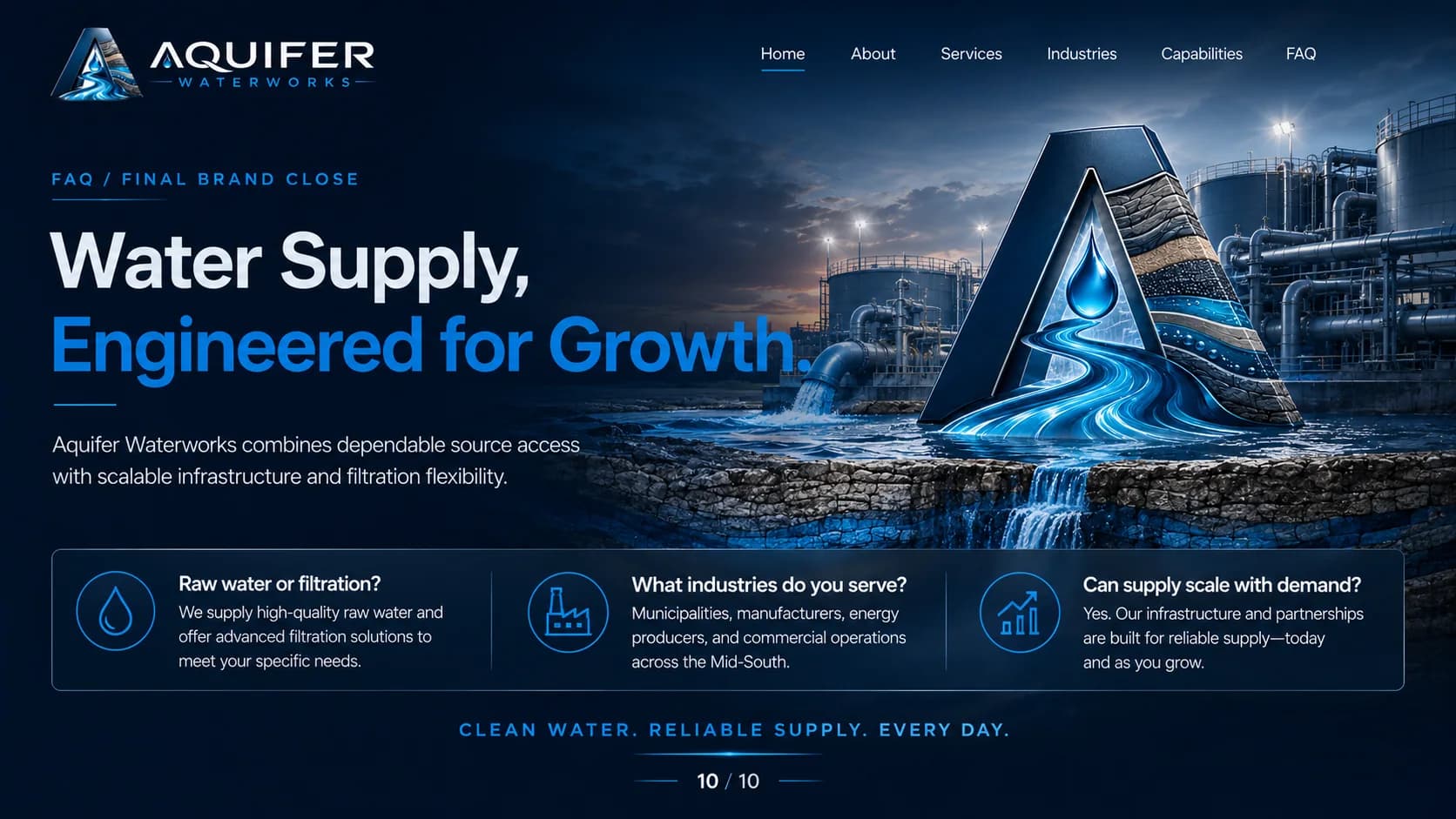
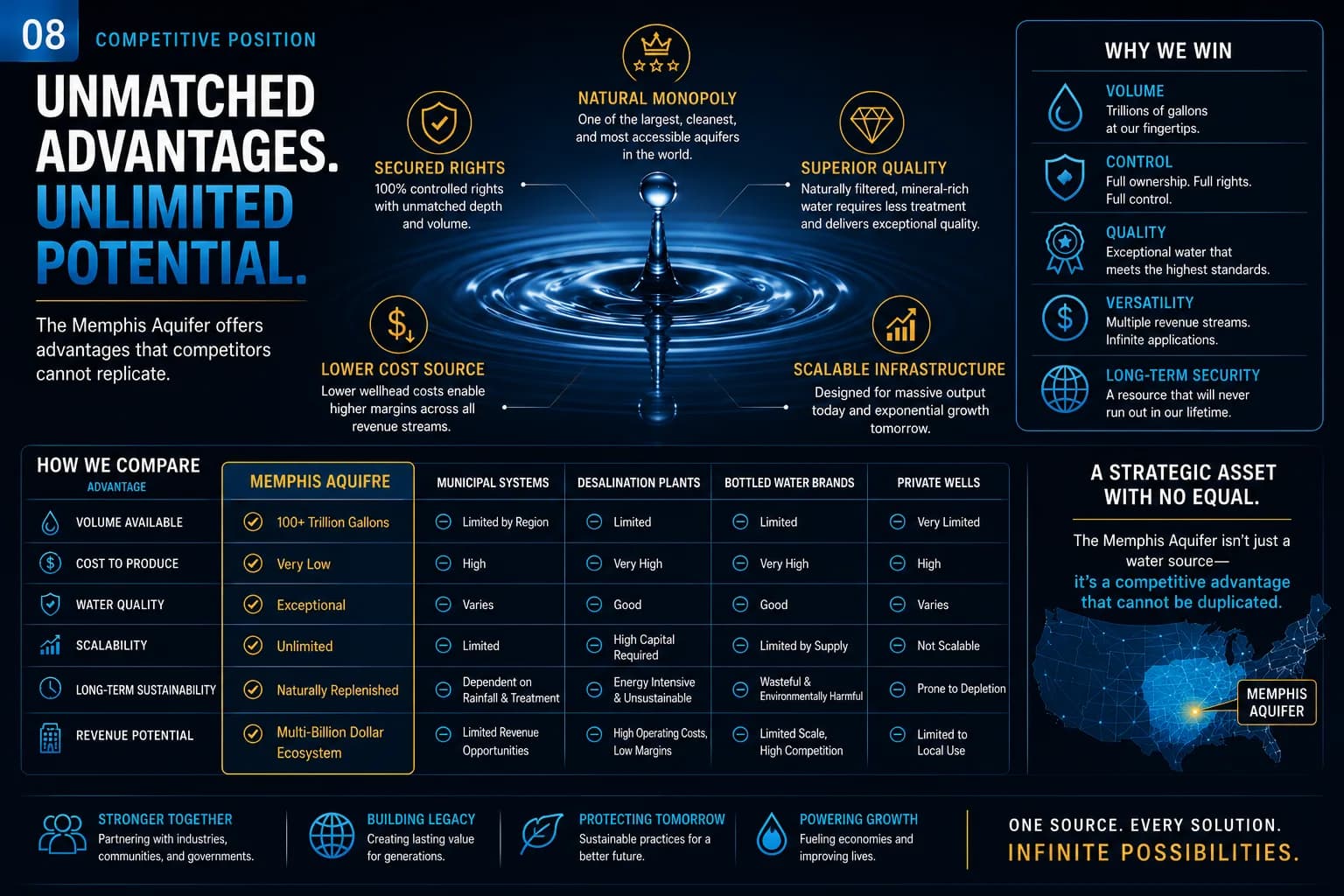
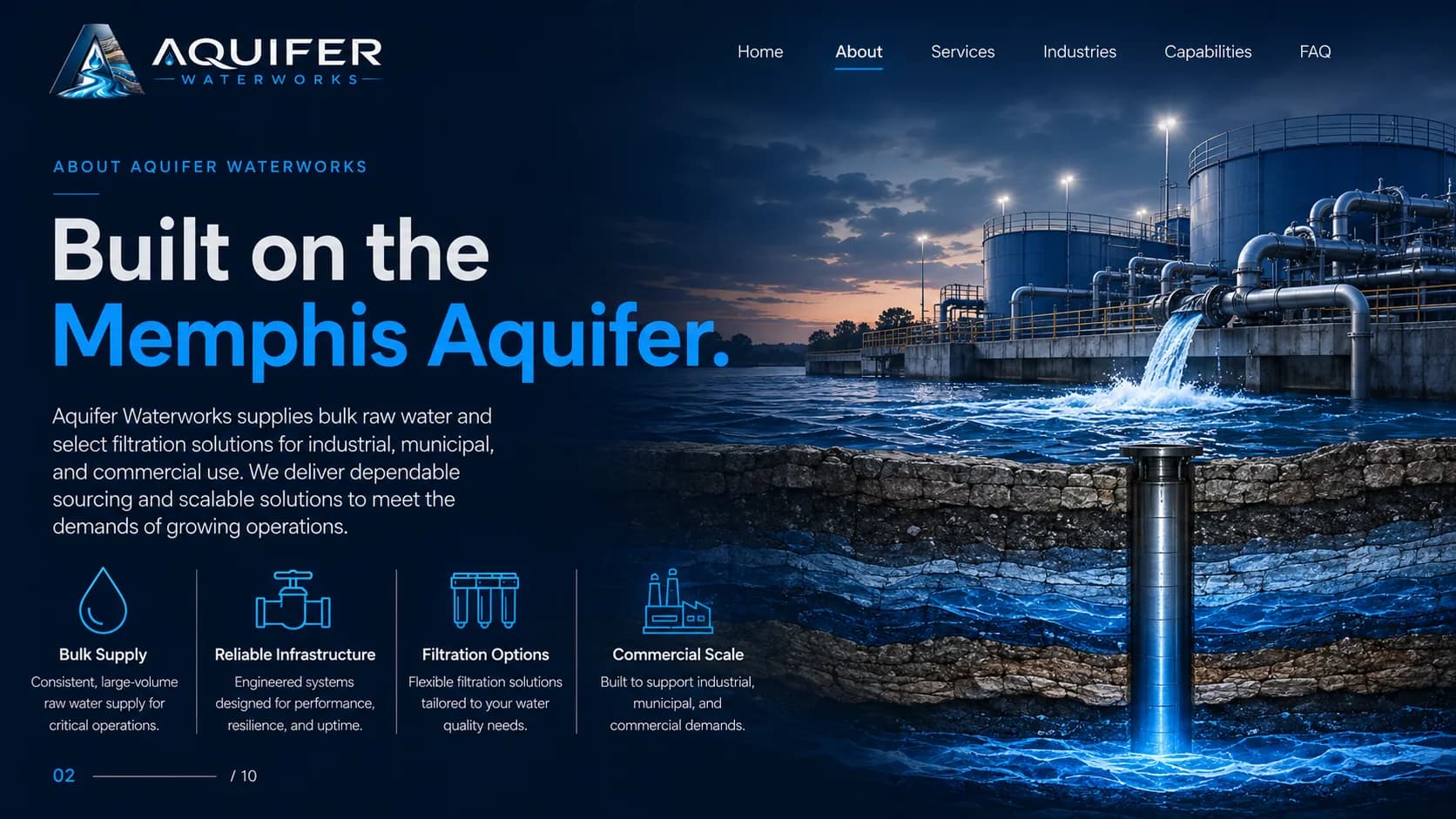
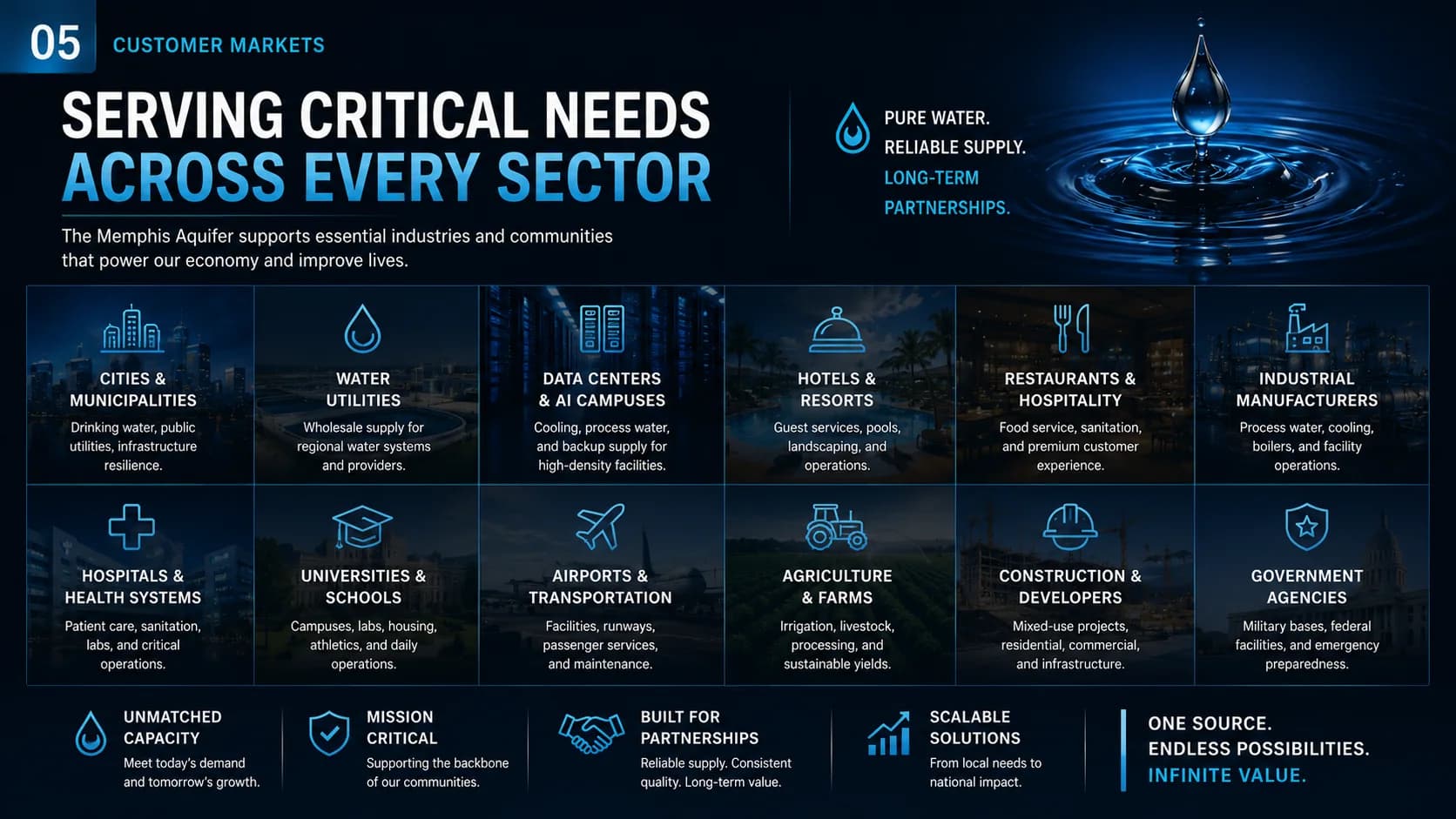
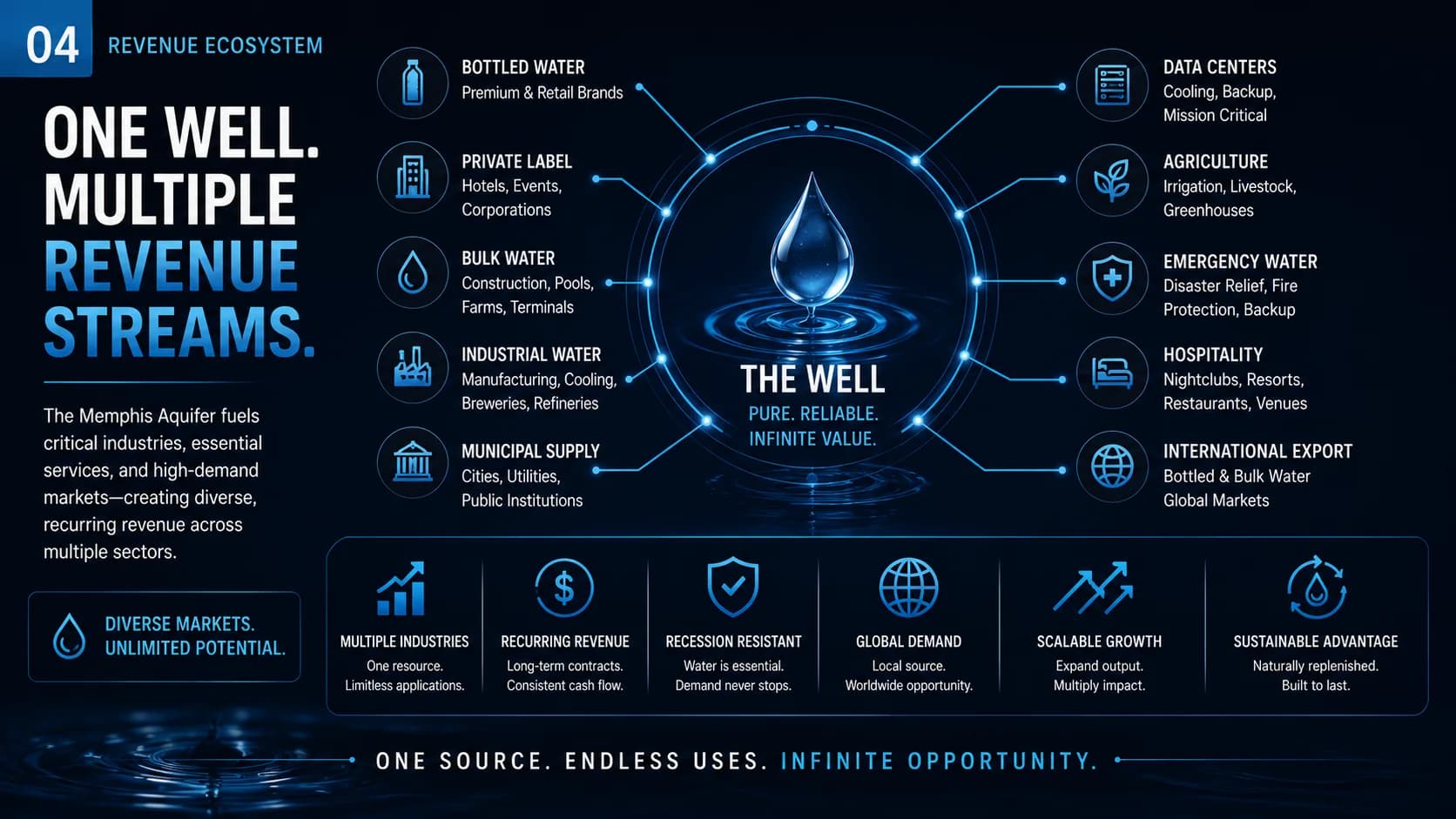
Commercial water-source capacity for industrial, municipal, data-center, emergency, and qualified bulk-water requirements.
SOURCE TRACE ACTIVE
THE SOURCE
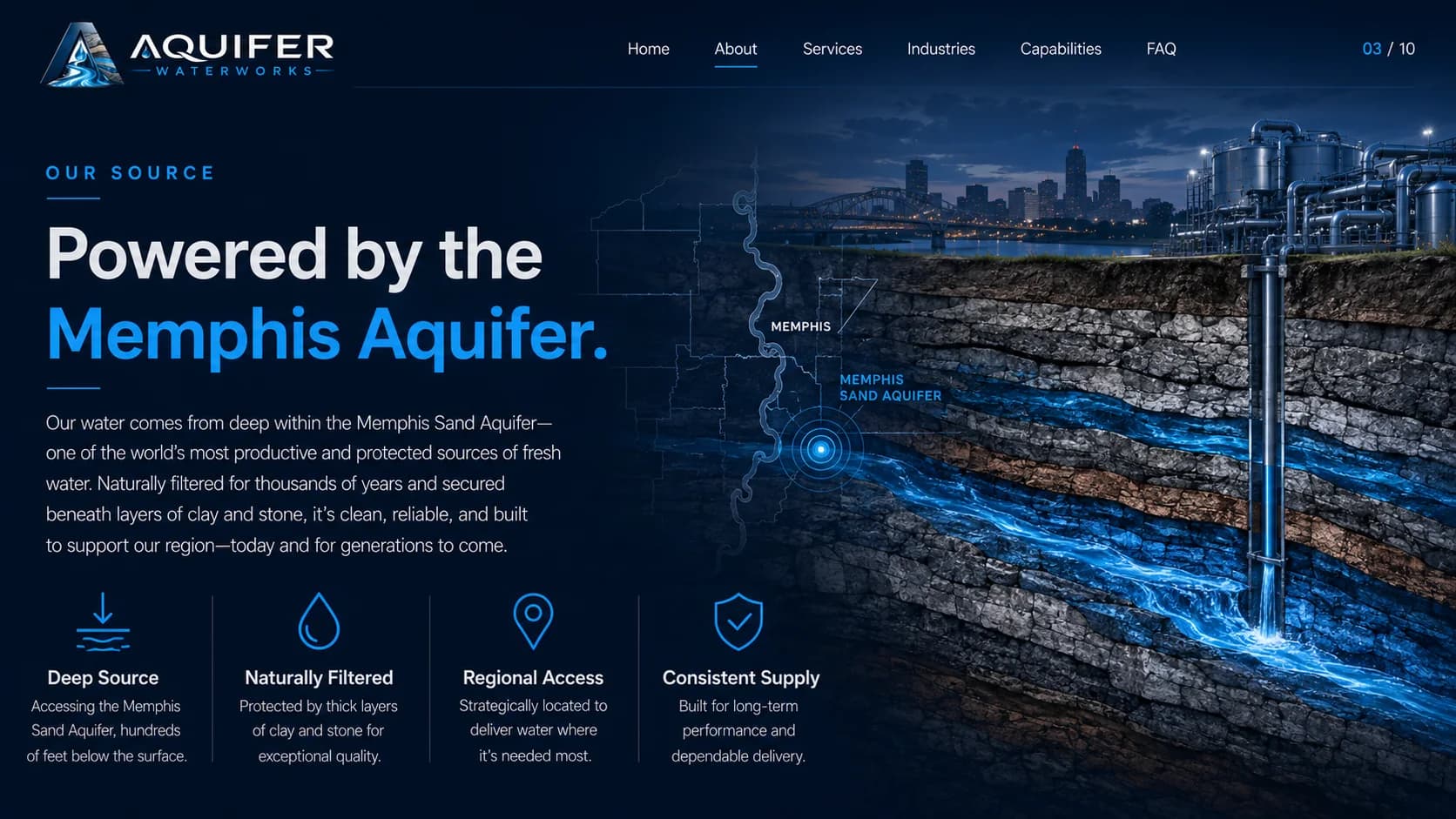
A confined aquifer system beneath the Memphis Region
The Memphis Region sits above a confined sand aquifer system — water-bearing sand units separated from surface conditions by overlying clay. That confining layer is the reason the resource is of commercial interest: it isolates the producing zone from surface runoff, agricultural return flow, and seasonal turbidity events that govern the quality profile of river and reservoir intakes. Source water drawn from a confined unit arrives with a comparatively narrow constituent range and a stable temperature, before any treatment step is applied.
Source water is the product. Everything downstream is scoped separately.
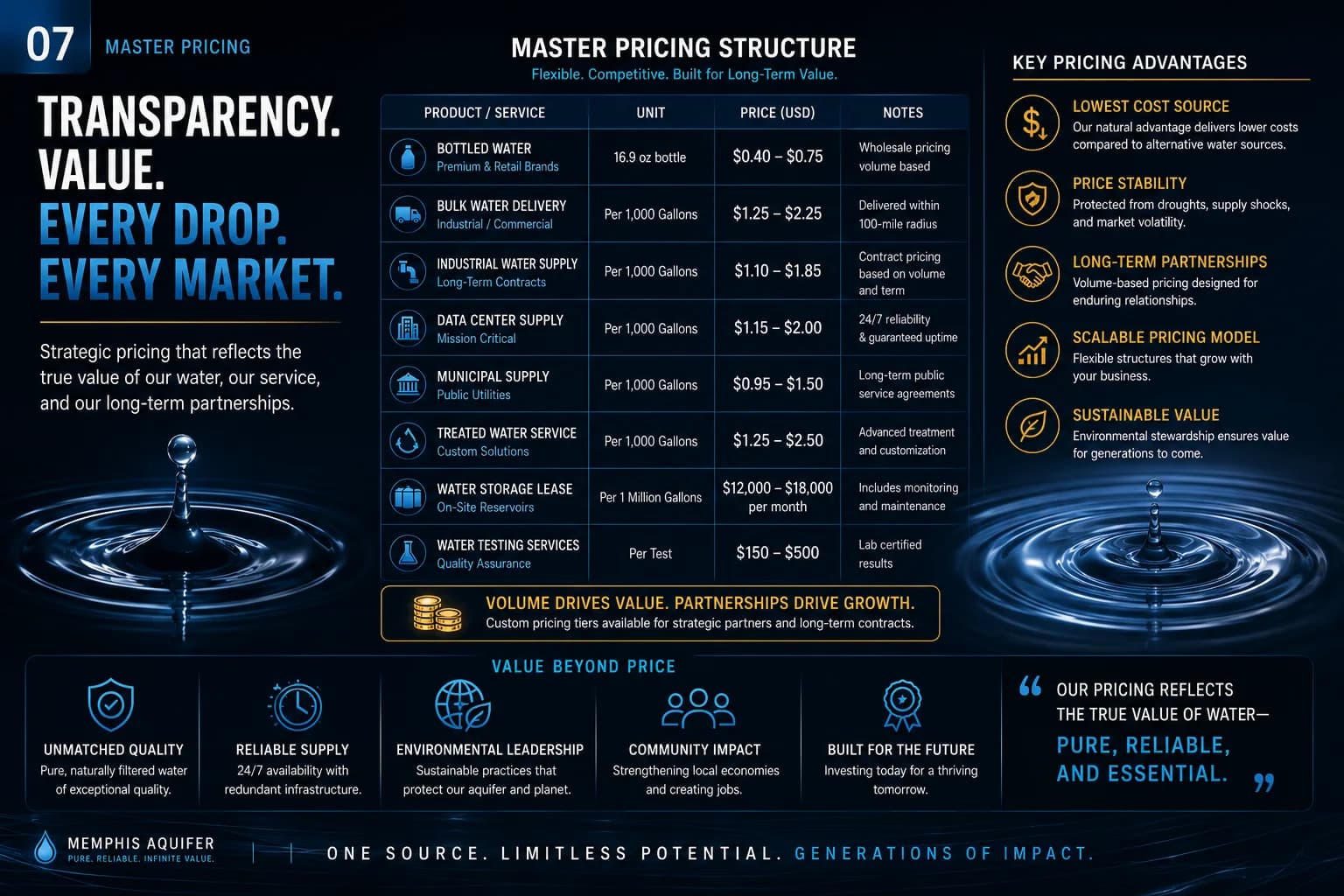
Most water suppliers quote a delivered, treated unit price and bury the cost structure inside it. Aquifer Waterworks does the opposite. The raw source-water commodity is priced on its own line. Filtration, treatment, storage, loading, hauling, pipeline work, and interconnection are each evaluated, engineered, and priced as separate scopes — and are added only where the buyer’s operating plan actually requires them.
Every inquiry enters the same technical qualification sequence, regardless of counterparty size. The first stage captures the operating profile: intended use, required constituent specification, average and maximum draw, peak-hour behaviour, cadence, receiving configuration, site access, and target start date. Without those inputs there is no basis for a defensible quote, and Aquifer Waterworks will not issue pricing against an incomplete profile.
Industrial process and cooling loads are the clearest fit. Operators running their own conditioning trains want a consistent, low-variance feed and full control of the chemistry downstream of the meter. A treated municipal feed is often over-specified for that duty and priced accordingly; a raw source-water feed against a defined constituent range is the more economic input where the site already carries treatment capability.
A commercial enterprise operating inside a regulated resource
Aquifer Waterworks is a private strategic enterprise. It is not a utility, not a water authority, not a regulator, and not a governmental body of any kind. It holds no regulatory power, issues no permits, sets no policy, and speaks for no public agency. Where this site describes permitting, compliance, or resource conditions, it is describing the framework the enterprise operates inside — not authority the enterprise possesses.
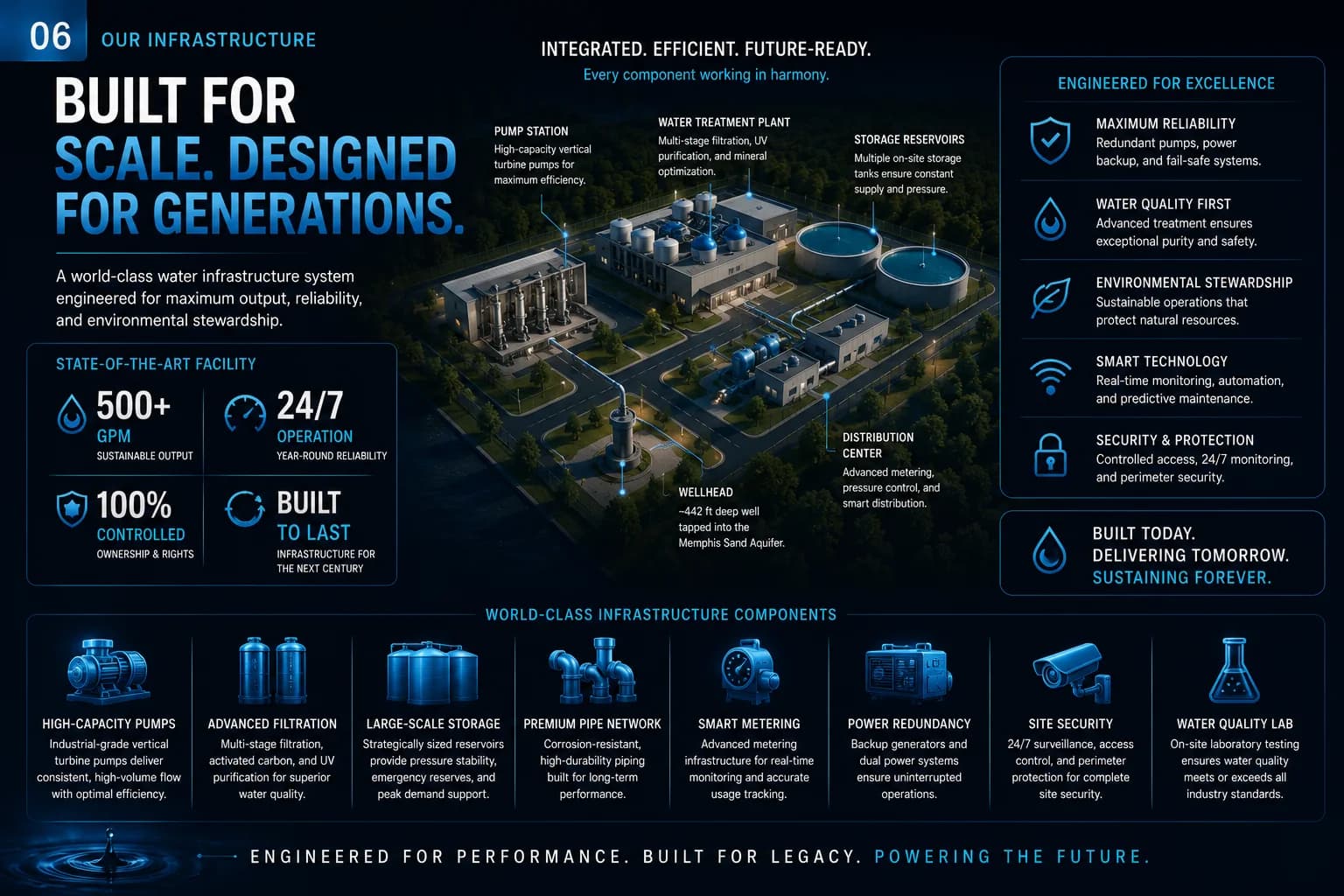
Public-facing material from Aquifer Waterworks is deliberately limited to what can be said without exposing operating detail. Production figures, draw data, wellhead and field siting, infrastructure schematics, and logistics routing are not published. Counterparties occasionally read that restraint as evasiveness; it is the opposite. Infrastructure detail published openly becomes a liability for every party that depends on it, including the buyer.
A source can be technically suitable and commercially unusable if the delivery path is not solved. Interconnection requires a defined handoff point, compatible pressure and flow conditions, metering, controls, backflow or isolation, easements, construction responsibility, commissioning, and the approvals that apply to the buyer and supplier. Loading requires storage, pumps, connection standards, traffic and turning, scheduling, driver procedures, and safe access. Hauled delivery adds carrier qualification, equipment, trip timing, receiving, and contingency.
Raw water does not have one universal pass or fail. A constituent level that is acceptable for one cooling, industrial, treatment, or blending process may be unacceptable for another. Qualification therefore begins with the buyer's intended use and written specification, then compares available analytical information against that requirement and identifies the treatment or monitoring questions that remain.
Spot, Recurring, Standing, and Reserved Capacity Are Different Products
Spot supply addresses a defined requirement and window without assuming future availability. Recurring supply sets a repeated volume and cadence under agreed terms. Standing supply establishes an ongoing operating relationship with schedules, forecasts, and review points. Reserved standby capacity compensates the supplier for maintaining readiness or priority against a defined contingency, whether or not the buyer consumes the full reserved volume.
A reserve program starts with the event being planned for: primary-source interruption, infrastructure failure, drought condition, construction outage, contamination response, peak demand, or another defined scenario. The buyer states the required response time, duration, volume profile, quality or treatment requirement, delivery path, storage, site access, receiving staff, communications, and the conditions that trigger activation.
What Technical Buyers, Source Partners, and Builders Bring
Technical buyers bring the operating profile and specification. Source or land partners bring evidence of control, permits, historical and current records, infrastructure, access, existing obligations, known constraints, and the commercial relationship they want considered. Engineering, construction, logistics, treatment, storage, equipment, and capital partners identify the exact work package, comparable experience, delivery capacity, insurance or bonding, schedule, and commercial expectations.
What to Know Before Requesting Technical Data or Supply
Aquifer Waterworks is a private commercial source-water supplier in the Memphis Region. Its primary offer is raw or untreated source water. It is not a public utility, regulator, water authority, government entity, bottled-water brand, or owner of the regional aquifer. Treatment, storage, loading, hauling, pipeline, and interconnection are separate scopes added only when a qualified program requires them.